
"Puerto Rico agriculture"
200 article(s) found

Fresh and elegant Dominica Santo Domingo Coffee Flavor taste Manor characteristics of boutique coffee
In 1795, France and Spain signed the Basel Peace Treaty in Switzerland, agreeing to cede the Santo Domingo area in the eastern part of the island of Dominica to France, making the Spanish island a complete French colony. Six years later, Toussaint Lovidur, a black Haitian, led other black slaves to revolt against French rule and captured Santo Domingo in 1801.

Introduction to the variety and flavor of the fresh, elegant and full-grained coffee manor in Dominica
After Santo Domingo returned to Spanish rule, the local people gradually formed a consensus on independent statehood. On November 30th, 1821, the former Governor of Santo Domingo, General Jos Nez de Cceres, proclaimed the founding of the country, named Haiti, Spain, and expected to merge under the Greater Colombian State led by President Bolivar of South America. [3] but in February 1822, nine weeks later, Haiti's

Introduction to the characteristics of Dominican Santo Domingo Coffee Flavor Manor with rich aroma and mellow taste
After Santo Domingo returned to Spanish rule, the local people gradually formed a consensus on independent statehood. On November 30th, 1821, the former Governor of Santo Domingo, General Jos Nez de Cceres, proclaimed the founding of the country, named Haiti, Spain, and expected to merge under the Greater Colombian State led by President Bolivar of South America. [3] but in February 1822, nine weeks later, Haiti's

Introduction to the flavor and taste characteristics of boutique coffee beans in Dominica coffee producing areas
After Santo Domingo returned to Spanish rule, the local people gradually formed a consensus on independent statehood. On November 30th, 1821, the former Governor of Santo Domingo, General Jos Nez de Cceres, proclaimed the founding of the country, named Haiti, Spain, and expected to merge under the Greater Colombian State led by President Bolivar of South America. [3] but in February 1822, nine weeks later, Haiti's

Starbucks Guatemala Antigua Coffee American Coffee Taste processing method
The Starbucks Antigua Coffee American Coffee production method in Guatemala was followed by a series of destructive earthquakes. In 1543, Santiago de Mayor was rebuilt in Antigua and Guatemala. Another earthquake in 1717 led to a building boom. During this period, a large number of important buildings were rebuilt. Another earthquake in 1775 made the city

Introduction to the flavor and taste of high-quality coffee beans in Dominica Coffee Manor
After the return of Santo Domingo to Spanish rule during the Haitian occupation (1821-1844), the local people gradually formed a consensus on independent statehood. On November 30th, 1821, the former Governor of Santo Domingo, General Jos Nez de Cceres, proclaimed the founding of the country, named Haiti, Spain, and expected to merge under the Greater Colombian State led by President Bolivar of South America. [3] but

Flavor and taste characteristics of coffee manor in Dominica Coffee Bean introduction to Santo Domingo Coffee
After Santo Domingo returned to Spanish rule, the local people gradually formed a consensus on independent statehood. On November 30th, 1821, the former Governor of Santo Domingo, General Jos Nez de Cceres, proclaimed the founding of the country, named Haiti, Spain, and expected to merge under the Greater Colombian State led by President Bolivar of South America. [3] but in February 1822, nine weeks later, Haiti's

A brief introduction to the history and culture of the origin and development of Dominican boutique coffee
Boutique coffee has become popular in recent years. High-quality coffee beans produced by some Dominican estates have a rich aroma, mellow taste and moderately bright sour taste, which are not far from the more famous Puerto Rico beans or Jamaican beans, and are also worth tasting. Dominica coffee beans have moderate acidity and rich fruit flavor. Western Hispaniola, 1500 m above sea level

A brief introduction to the origin, development, history and culture of Dominica boutique coffee beans with excellent acidity
The best place to produce is the Barahona region in the southwest, but Juncalito and Ocoa also produce a fine coffee, Santo Domingo coffee, which is characterized by freshness and elegance, fullness, excellent acidity and pleasant aroma, so it is worth it. Unlike coffee produced in Haiti, Dominica has a total of

Major producing countries and their famous coffee bean producing areas
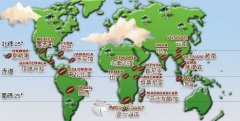
Latin America (Central and South America) Brazil: Santos, Bahia, Cerrado, Mogiana Mexico: Coatepec, Huatusco, Orizaba, Maragogype, Tapanchula, Huixtla, Plumakois
A list of well-known coffee beans in the world
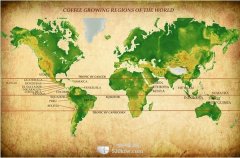
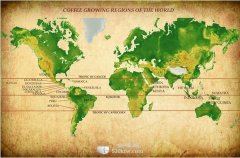
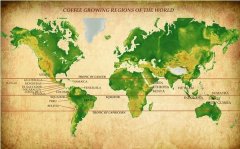
Coffee trees grow in tropical or subtropical agricultural gardens centered around the equator and called coffee belts.
Major coffee-producing countries
Latin America (Central and South America) Brazil: Santos, Bahia, Cerrado, Mogiana Mexico: Coatepec, Huatusco, Orizaba, Maragogype, Tapanchula, Huixtla, Plumakois
Introduction of major producing countries and their famous coffee bean producing areas
Latin America (Central and South America) Brazil: Santos, Bahia, Cerrado, Mogiana Mexico: Coatepec, Huatusco, Orizaba, Maragogype, Tapanchula, Huixtla, Plumakois
Major coffee producing countries in the world and their famous coffee bean producing areas
Latin America (Central and South America) Brazil: Santos, Bahia, Cerrado, Mogiana Mexico: Coatepec, Huatusco, Orizaba, Maragogype, Tapanchula, Huixtla, Plumakois
Introduction of Coffee from 53 Coffee producing areas in the World (2)
eleven. Mexico coffee from the world's fourth largest coffee producer, slippery and fragrant Mexico, the fourth largest coffee producer in the world, produces about 5 million bags of coffee a year. Most of its coffee is produced by nearly 100000 small farmers, and large estates that once manipulated the coffee industry are rare. The yield of Mexican coffee is about 630 kg per hectare. Later, the Mexican Coffee Association (Institu)

The main producing countries of boutique coffee and their famous coffee bean producing areas
Latin America (Central and South America) Brazil: Santos, Bahia, Cerrado, Mogiana Mexico: Coatepec, Huatusco, Orizaba, Maragogype, Tapanchula, Huixtla, Plumakois
Coffee mellow Journey (12) Haitian Coffee-fragrant "gone with the Wind"
Haiti was the first independent country in Latin America and the first black republic. Although it is now one of the poorest countries in the world, Haiti has a glorious past. In 1780, 40% of sugar and 60% of coffee on the European market came from Haiti. Haiti produces more of these agricultural products than the entire West Indies combined. In 1791, sugar production in Haiti
Where do the major producing countries and their famous coffee bean producing areas produce coffee? Where is the coffee?
Latin America (Central and South America) Brazil: Santos, Bahia, Cerrado, Mogiana Mexico: Coatepec, Huatusco, Orizaba, Maragogype, Tapanchula, Huixtla, Plumakois

History of Coffee Origin of Coffee processing species
Types of coffee beans World Coffee production Brazil Coffee Fruit (Arabica) Coffee on the market are mainly Coffee Arabica, Coffee Robusta and Coffee Liberica. Each of them can be subdivided into more variety branches. The origin of coffee beans and most of the coffee beans in circulation in the market

Introduction to the taste of the fresh, elegant and full-grained boutique coffee manor in Dominica
After Santo Domingo returned to Spanish rule, the local people gradually formed a consensus on independent statehood. On November 30th, 1821, the former Governor of Santo Domingo, General Jos Nez de Cceres, proclaimed the founding of the country, named Haiti, Spain, and expected to merge under the Greater Colombian State led by President Bolivar of South America. [3] but in February 1822, nine weeks later, Haiti's